


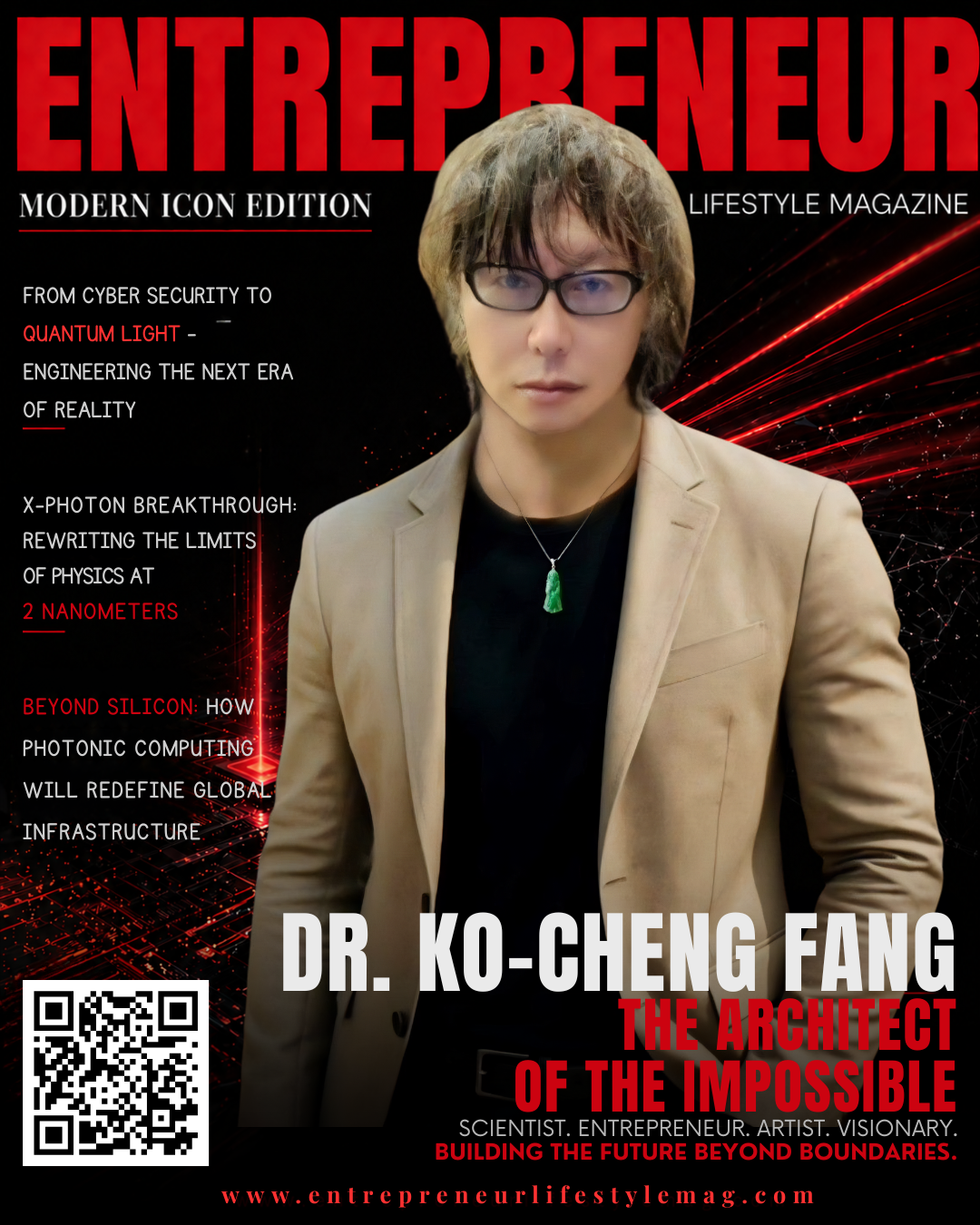
How a systems thinker is reshaping the boundaries between science, strategy, and societal progress
Introduction: Beyond the Age of Specialization
For decades, expertise has been defined by depth—how far one could drill into a single domain. But in an era shaped by complexity, the most consequential breakthroughs are no longer emerging from silos. They are born at intersections.
Few figures embody this shift as fully as Dr. Ko Cheng Fang—a scholar, strategist, and architect of ideas whose work challenges the very premise of specialization. Rather than mastering a single discipline, he has built a career on connecting them, weaving together frameworks that span science, business, and systems thinking.
His story is not just about personal achievement. It is about a broader transformation in how innovation itself is conceived.
The Making of a Systems Thinker
Dr. Fang’s intellectual trajectory reflects a deliberate resistance to conventional academic pathways. Where traditional careers reward narrowing focus, his approach has consistently leaned toward expansion—seeking patterns across seemingly unrelated domains.
This orientation aligns closely with the principles of systems thinking, an approach that views problems not as isolated events but as parts of interconnected networks. Whether examining organizational strategy or technological development, Fang’s work emphasizes relationships over components, dynamics over static models.
Such thinking is increasingly critical in a world where challenges—climate change, digital transformation, global supply chains—refuse to stay neatly contained within disciplinary boundaries.
Innovation at the Intersections
What distinguishes Fang is not simply that he works across disciplines, but how he integrates them. His methodology often combines:
- Analytical rigor from scientific research
- Strategic frameworks from business and management
- Conceptual modeling from systems theory
This synthesis allows him to approach problems from multiple vantage points simultaneously. Instead of asking, “What is the solution within this field?” he reframes the question: “What emerges when multiple fields are allowed to inform one another?”
In practice, this has led to insights that are less about incremental improvement and more about structural rethinking—rethinking how organizations innovate, how knowledge is transferred, and how leadership adapts to uncertainty.
The Shift from Expertise to Integration
Fang’s work arrives at a moment when the limitations of hyper-specialization are becoming increasingly visible. Industries once driven by linear progress are now shaped by convergence:
- Technology intersects with healthcare
- Finance merges with data science
- Education blends with digital ecosystems
In this context, the ability to translate between domains becomes as valuable as expertise within one.
Dr. Fang represents a new archetype: not the specialist, but the integrator. His work suggests that the future belongs to those who can navigate ambiguity, synthesize diverse inputs, and construct frameworks that accommodate complexity rather than reduce it.
Thought Leadership in a Fragmented World
Beyond his direct contributions, Fang’s influence extends through his thought leadership—his ability to articulate ideas that resonate across industries.
In interviews and public discourse, he often returns to a central theme: innovation is not merely about invention, but about connection. The most transformative ideas, he argues, arise when previously disconnected systems begin to interact.
This perspective has implications far beyond academia or business. It challenges institutions to rethink how they educate, how they collaborate, and how they define expertise itself.
Why His Work Matters Now
The urgency of Fang’s approach becomes clear when viewed against today’s global landscape. Organizations are grappling with:
- Rapid technological disruption
- Increasingly complex global interdependencies
- The need for adaptive, resilient strategies
Traditional models—linear, siloed, and predictable—are proving insufficient.
By contrast, interdisciplinary frameworks offer a way forward. They enable organizations to anticipate ripple effects, identify hidden opportunities, and respond more holistically to change.
Fang’s work does not provide simple answers. Instead, it offers a more powerful tool: a way of thinking that makes better answers possible.
Conclusion: Designing the Future Through Connection
Dr. Ko Cheng Fang’s career is a testament to a quiet but profound shift in how knowledge is created and applied. In moving beyond the confines of single disciplines, he has helped illuminate a path toward more integrated, adaptive forms of innovation.
His work suggests that the future will not be shaped by those who know the most about one thing—but by those who understand how many things fit together.
In that sense, Fang is not just contributing to innovation. He is redesigning its architecture.


Leave a Reply Cancel reply